

Didier Ramos Silva Co
October 12, 2026
/ 13 Minutes
Sustainability in the MICE industry: where organisers can make a difference
Didier Ramos Silva Co
October 12, 2026
/ 13 Minutes
Travel matters most: According to atmosfair, up to 70% of an event’s emissions come from travel to and from the venue. Planning here achieves more than decoration or printed materials.
Pooling works immediately: Pick-up points, shuttles and the right vehicle sizes reduce emissions per person. The programme does not need to change.
Only substantiated claims: Since 27 September 2026, stricter rules on environmental and sustainability claims have applied in Germany. Blanket terms such as ‘climate neutral’ are now a risk.
Whether it is a sales conference, an incentive trip or a specialist congress, MICE events bring people together from many places, often for just one or two days. Getting there often causes more emissions than everything that happens on site. The article MICE explained covers what the four letters stand for. This article looks at where organisers can actually make a difference and how they can prove it.
In tenders and supplier assessments, procurement departments often ask about environmental management, credentials and data. For agencies and service providers involved in an event, this means that those without answers fall behind in the assessment.
Reporting adds to this. Under the EU Corporate Sustainability Reporting Directive (CSRD), large companies must publish a sustainability report. The EU has significantly narrowed the group of companies required to report with the Omnibus package (in German). The topic still matters for everyone else: companies that are required to report need data from their supply chain. Business travel to meetings and conferences can feed into their greenhouse gas inventory.
The guide to the sustainable organisation of events (in German) by the German Environment Agency and the Federal Environment Ministry gives an overview of where an event’s emissions arise. It covers fields of action such as the procurement of products and services as well as organisation, communication and evaluation, and offers support in recording emissions. At many events, attendee travel is the largest item. Catering, energy and materials remain important. But planning travel first achieves the most.
If you don’t want to reinvent sustainability for every event, you can rely on established frameworks. ISO 20121 concerns the management of the event itself. From service providers such as caterers or transport partners, organisers can request their own credentials, for example environmental management to ISO 14001 or an independent assessment of their sustainability management.
| Framework | What it is | Suitable for |
|---|---|---|
| ISO 20121 | Standard covering the entire value chain of an event, from supplier selection through transport to communication | Organisers and agencies who want to build a certifiable management system |
| fairpflichtet | Sustainability code of the German-speaking events industry, launched in 2012 by GCB and EVVC as a voluntary commitment | Companies in the industry that want to commit to shared guidelines |
| Green Globe | Certification open to venues and hotels, among others | Choosing venue and accommodation |
| UBA guide | Fields of action, checklists and guidance on recording emissions | Getting started with planning, even without certification |
Transport is often planned only once the venue and programme are fixed. For emissions, that is late, because the most important decision is made when choosing the venue. Whether a venue is easy to reach by rail, how far away the hotels are and where coaches can stop all influence how many attendees travel without their own car. Timing matters just as much: if you know attendee numbers, home regions and the schedule early on, you can pool journeys instead of filling individual gaps later. Four levers make the difference: location and the last mile, pooling, vehicle size and occupancy, and the drive type.
If the venue is close to a mainline railway station, rail is the obvious choice for many attendees.
The last mile then makes the difference. An event shuttle from the station to the venue replaces many individual journeys, as does an airport transfer for international guests. Organisers should time the shuttle frequency to train arrivals, not just to the start of the programme.
For incentive trips, it is worth looking at destinations within coach range. Instead of a short-haul flight, the journey becomes part of the programme, and the group stays together from departure to return.
Every person who does not travel alone by car or taxi reduces emissions per head. The mobility checklist accompanying the federal guide (in German) explicitly lists shared use of means of transport and an organised shuttle service as measures. In practice, this means:
a shuttle service between hotels and venue
fixed pick-up points in the city
for trade fairs, a trade fair transfer for exhibitors and guests
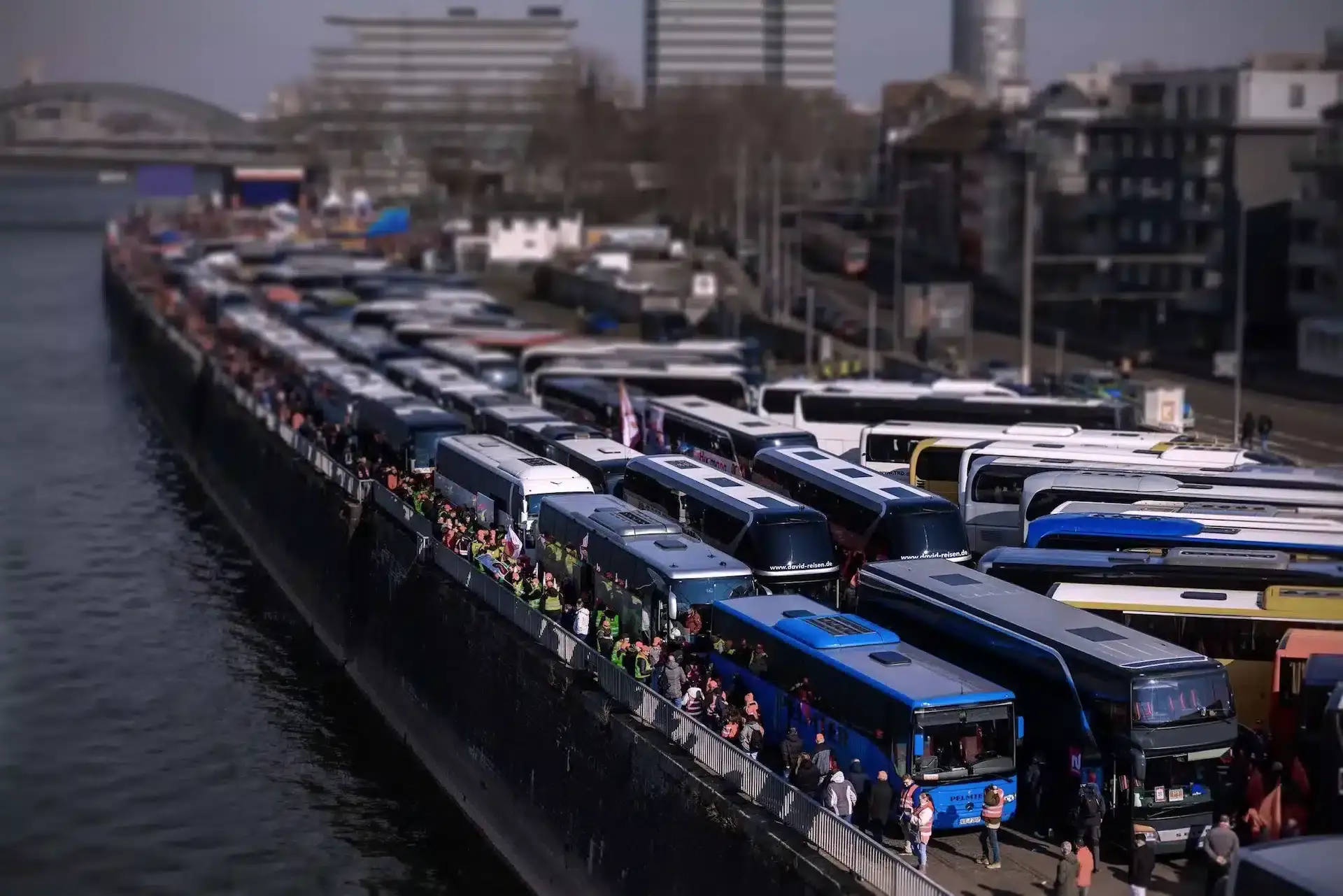
If attendees come from many regions, multi-departure transport with coaches from their home locations is a good fit. Even a very large number of departure points can be brought together in one transport plan, as in the multi-departure transport (‘Sternfahrt’) for a trade union, 2025: 48,896 passengers, around 150 departure points, five parallel large-scale events, more than 1,200 buses and more than 240 partner operators.
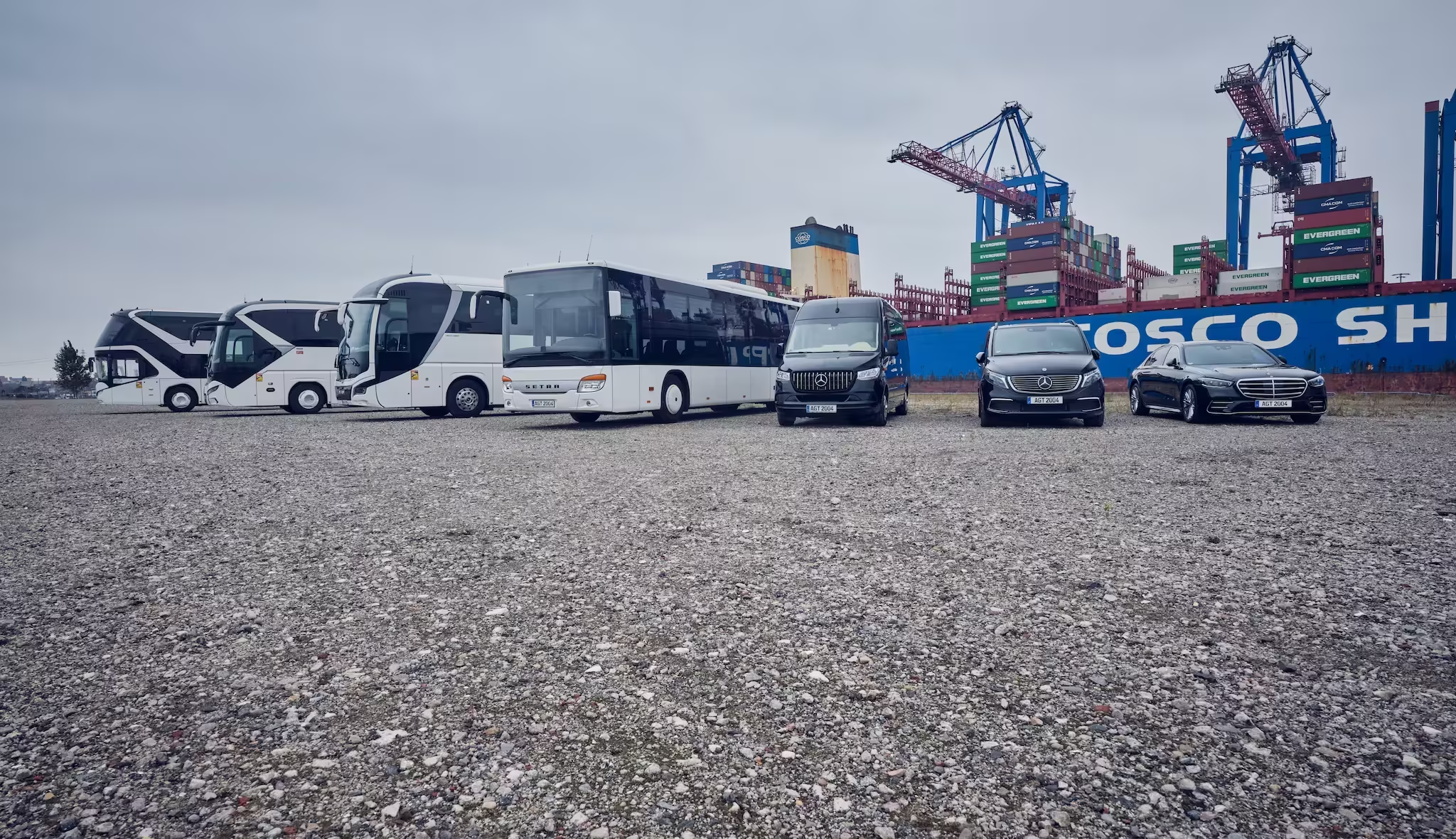
How much a shuttle achieves depends on how full the vehicles are. A coach that runs back and forth half empty all day uses more per passenger than necessary. Through agt, you can choose from five standard classes:
Van (1–7)
Minibus (8–18)
Coach (19–50)
Coach XL (51–57)
Double-decker coach (58–75)
Larger groups travel in several vehicles. The bus size comparison gives an overview.
There is a trade-off here. For departure, it is advisable to keep more seats available than strictly needed, so that nobody has to wait long after the programme. But this reserve does not have to travel all day. It can be covered by a shorter frequency at peak times or by a vehicle that is only deployed when needed. Outside peak times, fewer journeys or smaller vehicles are often enough.
The second lever is empty runs. A bus that takes guests to the venue and then returns empty causes emissions without any benefit. Rotations in which the vehicle picks up the next group straight away, and waiting times that match the programme, are better. Bus coordination aligns journeys, time slots and vehicles.
For fuel and drive systems, there are alternatives to fossil diesel, such as HVO or electric buses. The articles Sustainable fuels compared and HVO diesel explained describe what they can do and where their limits lie.
Without data, sustainability remains a claim. The most important source is registration. The mobility checklist recommends asking for the mode of travel at registration. This makes it possible to estimate shuttle demand early and to calculate the footprint later.
After the event, organisers should request the journey data from their transport partner:
number of journeys
kilometres driven, including the vehicles’ journeys to and from the job
vehicle class
number of passengers
Tools for the calculation include the German Environment Agency’s CO₂ calculator for events and atmosfair’s CO₂ event calculator.
Every figure needs its method: which calculator, which emission factors, which assumptions. Only then can two events be compared.
| KPI | Data source | Purpose |
|---|---|---|
| Share of attendees travelling by rail, shuttle or multi-departure transport | Registration, shuttle passenger counts | Effect of the transport plan |
| Average occupancy per journey | Transport partner’s journey data | Review vehicle size and frequency |
| Empty kilometres | Transport partner’s journey data | Improve rotations |
| Emissions per attendee | Calculation with a calculator, method stated | Comparison between events, data for clients |
With the data comes the question of what can be said publicly. To implement the EmpCo Directive, Germany amended its Act against Unfair Competition (UWG). The stricter requirements for environmental claims and sustainability labels (in German) have applied since 27 September 2026. The key points:
General environmental claims such as ‘environmentally friendly’, ‘climate friendly’ or ‘sustainable’ are not permitted without proof.
‘Climate neutral’ or ‘CO₂ neutral’ is prohibited if the claim is based solely on offsetting. This applies even if the offset projects are actually carried out.
Sustainability labels are only permitted if they are based on official certification schemes or have been established by public authorities.
The rules primarily protect consumers. Infringements are mainly pursued by consumer and competition associations and by competitors. Whether event communication is aimed at consumers depends on the individual case, for example at public trade fairs or public events. In B2B relationships, misleading claims are prohibited under the UWG anyway. The safest approach is the same in both cases: state specifically what was done, and be able to prove it.

The figures in the right-hand column are example values. This overview does not replace legal advice. For claims in advertising material or on the event website, it is worth checking each case individually.
| Instead of | Better |
|---|---|
| ‘Our conference is climate neutral.’ | ‘65% of attendees travelled by rail and shuttle. We calculated the event’s emissions with the German Environment Agency’s CO₂ calculator for events: 48 t CO₂e.’ |
| ‘Environmentally friendly shuttle service’ | ‘A shuttle runs every 15 minutes between the hotel and the conference centre. There is no need for individual journeys by taxi or car.’ |
| ‘A green event’ | ‘Catering with 70% regional produce, reusable tableware, electricity from renewable sources.’ |
Green meetings describes an approach to planning, running, documenting and further developing events in an environmentally sound way. All stakeholders are involved, from employees and service providers to attendees. The term alone is not proof. What matters are the measures behind it.